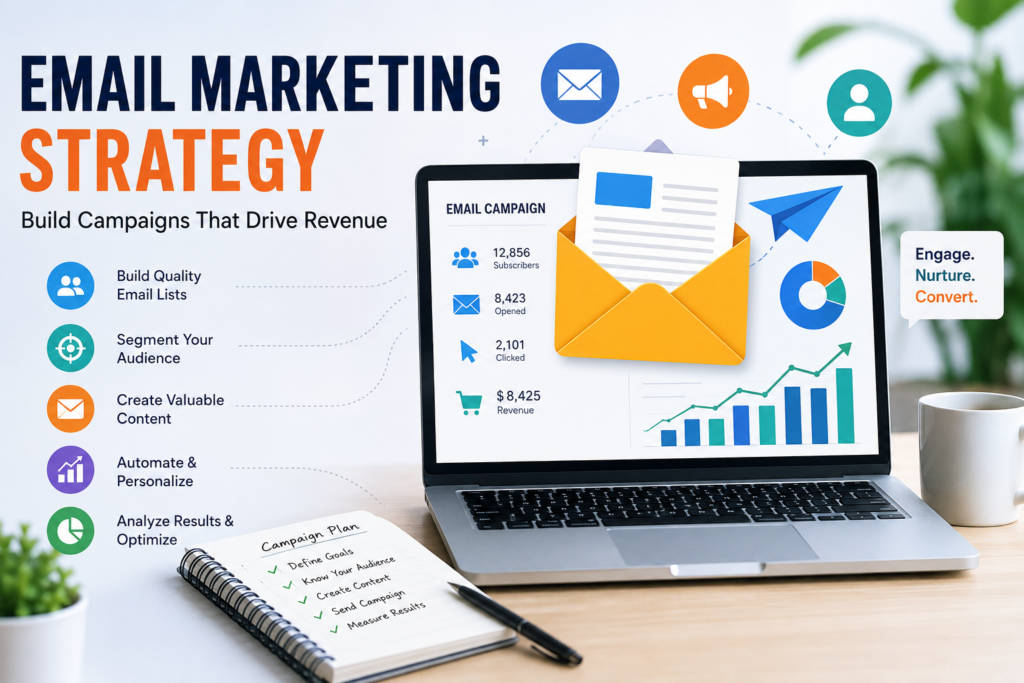
Email remains one of the most useful channels for businesses that want to communicate directly with customers. But sending more emails does not automatically produce more sales.
A strong email marketing strategy starts with understanding your audience, collecting permission appropriately, sending relevant content, and measuring what happens after each campaign. It also requires good email design, clear messaging, thoughtful segmentation, and regular testing.
Whether you run an online store, SaaS company, service business, publisher, or small website, the same principle applies: your subscribers should have a clear reason to open your emails and continue receiving them.
This guide explains how to build an email marketing strategy from the ground up, create effective campaigns, avoid common mistakes, and measure performance responsibly.
What Is an Email Marketing Strategy?
An email marketing strategy is a planned approach for using email to communicate with subscribers and customers in support of specific business goals.
Those goals might include:
- Introducing a new product
- Educating potential customers
- Increasing repeat purchases
- Welcoming new subscribers
- Recovering abandoned purchases
- Sharing useful content
- Retaining existing customers
- Promoting an event
- Re-engaging inactive subscribers
The strategy determines who receives an email, why they receive it, what the message contains, when it is sent, and how its results are evaluated.
A campaign is usually a specific execution of that strategy.
For example, an online clothing store might have a strategy centered on product education and repeat purchases. One campaign could introduce a new collection, while an automated welcome sequence explains sizing, care instructions, and popular products.
Why Email Marketing Needs a Strategy
Without a clear plan, email marketing can quickly become a collection of unrelated promotional messages.
A business might send a discount today, a newsletter tomorrow, and another product announcement next week without knowing whether the messages serve the same customer journey.
A strategy creates consistency.
It helps you answer practical questions such as:
- Who are you trying to reach?
- What problem are you helping them solve?
- What type of content should you send?
- How often should you email?
- Which subscribers should receive each campaign?
- What action should readers take?
- Which results indicate that a campaign worked?
The goal is not to send the maximum number of emails. The goal is to send useful messages to the right people at appropriate times.
Step 1: Define Your Email Marketing Goals
Start with one primary objective for each campaign.
Possible goals include:
Increasing product sales
If your objective is sales, your campaign should help subscribers understand the product and why it may be relevant to them.
For example, instead of simply writing:
“Buy our new product today.”
You could explain what changed, who the product is designed for, and what problem it addresses.
Generating leads
A business-to-business company might use email to encourage prospects to request a consultation, download a resource, or attend a webinar.
Improving customer retention
Retention campaigns can help customers get more value from something they already purchased.
For example, a software company could send an onboarding sequence showing customers how to use important features.
Increasing repeat purchases
An ecommerce business might send recommendations based on previous purchases, product replenishment reminders, or educational content related to products customers already own.
Your objective affects your email content, call to action, audience, and measurement.
Step 2: Understand Your Target Audience
Effective email marketing begins before you write the first subject line.
You need to understand your subscribers.
Consider:
- Their problems
- Their interests
- Their purchasing stage
- Their previous interactions
- Their questions
- Their preferred products or services
- Their level of familiarity with your business
A new subscriber usually needs different information from a long-term customer.
For example, someone who downloaded a beginner’s guide may need educational content. Someone who has purchased three times may be more interested in advanced products, loyalty benefits, or useful tips related to previous purchases.
Your emails become more relevant when you understand these differences.
Step 3: Build an Email List Responsibly
A quality email list is more valuable than a large list filled with people who never wanted your messages.
Use legitimate methods to attract subscribers, such as:
- Website signup forms
- Newsletter subscriptions
- Free educational resources
- Product updates
- Webinar registrations
- Account registration where marketing consent is appropriately handled
- Checkout opt-ins where legally permitted
- Relevant content upgrades
Make the signup process clear.
Tell people what they are signing up for and avoid hiding marketing consent inside unrelated terms.
For example:
Good:
“Subscribe to receive weekly marketing tips and occasional product updates.”
This gives the subscriber a reasonable understanding of what they will receive.
Avoid purchased email lists
Buying or renting email lists can create legal, privacy, reputation, and deliverability problems.
For example, UK ICO guidance says organizations sending electronic marketing to individuals generally need consent unless a specific exception applies. It also warns that publicly available contact information does not automatically mean the person has consented to marketing.
Rules differ by country, audience, and circumstances, so review the requirements that apply to your business before launching campaigns.
Step 4: Segment Your Email List
Segmentation means dividing subscribers into groups based on useful characteristics or behavior.
Instead of sending every email to everyone, you can create relevant audiences.
Common segmentation criteria include:
- New subscribers
- Existing customers
- Previous purchasers
- High-value customers
- Inactive subscribers
- Product interests
- Location
- Signup source
- Website behavior
- Purchase history
- Content preferences
For example, imagine you sell online courses.
Someone who purchased a beginner photography course could receive photography tutorials and recommendations for intermediate courses.
A subscriber who has only downloaded a free photography checklist could receive introductory educational content first.
The more relevant the message, the less reason you have to send unrelated promotions to your entire list.
Step 5: Create a Useful Email Content Plan
A good email marketing strategy should include different types of content.
Educational emails
Teach subscribers something useful.
Examples include:
- Tutorials
- Checklists
- How-to guides
- Industry explanations
- Product tips
- Case examples
- Common mistakes
Educational content can build familiarity before you ask someone to buy.
Promotional emails
Promotional emails communicate an offer, product launch, sale, or other commercial opportunity.
Keep the message clear.
Explain:
- What is being offered
- Who it is for
- What the customer receives
- Important conditions
- When the offer ends, if there is a genuine deadline
- What the reader should do next
Avoid fake urgency or misleading claims.
Newsletter emails
A newsletter can combine useful articles, company updates, product information, and curated resources.
The best newsletters have a clear editorial purpose rather than becoming a random collection of links.
Customer education emails
These emails help customers get more value from a product or service.
For example:
Email 1: Getting started
Email 2: Essential features
Email 3: Common mistakes
Email 4: Advanced tips
Email 5: Additional resources
This type of sequence can support customer satisfaction while also introducing relevant products or services.
Step 6: Build an Email Marketing Funnel
An email funnel describes how subscribers move through different stages of their relationship with your business.
A simple funnel might look like this:
Visitor → Subscriber → Engaged subscriber → Customer → Repeat customer
Different emails can support each stage.
Welcome stage
A welcome email should confirm the subscription and set expectations.
It might include:
- A welcome message
- The promised resource
- What subscribers can expect
- Links to useful content
- A simple next step
Education stage
Provide information that helps subscribers understand their problem and potential solutions.
Consideration stage
Introduce relevant products or services and explain how they work.
Purchase stage
Make the buying process clear and answer common objections.
Retention stage
Continue helping customers after the purchase.
This could include tutorials, product education, recommendations, or customer support resources.
Step 7: Write Better Email Subject Lines
Your subject line should accurately describe the email and give the reader a reason to open it.
Good subject lines are usually specific rather than vague.
Examples:
- 5 Ways to Improve Your Website Speed
- Your Guide to Choosing an Email Platform
- New: Three Features Added This Month
- How to Prepare Your Store for the Holiday Season
Avoid misleading subjects such as pretending a promotional email is a personal conversation when it is not.
The U.S. Federal Trade Commission’s CAN-SPAM guidance requires commercial emails to use accurate header information and non-deceptive subject lines, among other requirements.
Step 8: Make Your Email Copy Easy to Read
Most readers do not want to work through a large wall of text.
Use:
- Short paragraphs
- Descriptive headings
- Bulleted lists
- Clear calls to action
- Simple language
- Relevant links
- Enough spacing
Put the most important information near the beginning.
For example, if you are announcing a new guide, tell readers what the guide helps them accomplish before explaining the background.
Focus on one main action
An email can contain multiple links, but it should usually have one primary action.
Examples:
- Read the guide
- Start a free trial
- View the new collection
- Register for the webinar
- Complete your account setup
When everything is presented as equally important, the reader may struggle to decide what to do next.
Step 9: Create Effective Calls to Action
A call to action should clearly explain the next step.
Instead of generic wording such as:
Click Here
try:
- Read the Complete Guide
- View the New Collection
- Start Your Free Trial
- Download the Checklist
- Book a Consultation
The wording should accurately describe what happens after the click.
Do not use deceptive buttons or misleading calls to action designed primarily to generate clicks.
Step 10: Use Automation Carefully
Email automation allows you to send messages based on predefined events or subscriber behavior.
Common automated sequences include:
Welcome sequence
Triggered when someone subscribes.
Onboarding sequence
Triggered when someone becomes a customer or creates an account.
Abandoned-cart sequence
Triggered when an eligible customer leaves items in a shopping cart.
Post-purchase sequence
Triggered after a transaction.
Re-engagement sequence
Triggered after a subscriber becomes inactive for a defined period.
Automation saves time, but it still requires maintenance.
Review automated emails regularly to make sure:
- Links work
- Prices are current
- Products still exist
- Information is accurate
- Timing makes sense
- Unsubscribe mechanisms work
- Old promotions have been removed
An automated email can continue sending the wrong information long after the person who created it has forgotten about it.
Step 11: Protect Email Deliverability
Deliverability refers to your ability to get legitimate messages delivered to recipients rather than having them rejected or filtered as spam.
Several factors influence this, including:
- Subscriber engagement
- Sending reputation
- Authentication
- Complaint rates
- List quality
- Email content
- Sending practices
Google’s current Gmail sender guidance says senders should authenticate email, avoid unwanted or unsolicited messages, and make unsubscribing easy. Google also has additional requirements for senders reaching large volumes of Gmail accounts.
Use email authentication
Your domain should be configured appropriately for the email service you use.
Common authentication technologies include:
- SPF
- DKIM
- DMARC
Your email service provider will normally provide setup instructions. Follow its current documentation because configuration requirements can change.
Keep your list clean
Remove or suppress addresses that repeatedly bounce or subscribers who have remained inactive for a long period, depending on your business and re-engagement process.
A smaller, engaged audience can be more useful than a much larger audience that rarely interacts with your emails.
Step 12: Test Your Campaign Before Sending
A simple pre-send checklist can prevent embarrassing mistakes.
Check:
- Subject line
- Preview text
- Spelling
- Links
- Images
- Mobile layout
- Personalization fields
- Sender name
- Reply address
- Unsubscribe link
- Offer details
- Dates and prices
- Tracking parameters
Send a test email to yourself and, where practical, review it on more than one device.
Pay particular attention to automated personalization.
A message that says:
“Hi [First Name]”
because a variable failed is a small technical problem that can make a campaign look unprofessional.
Step 13: Test Different Campaign Elements
Testing can help you make better decisions based on actual subscriber behavior.
You might test:
- Subject lines
- Calls to action
- Email length
- Images versus text
- Offers
- Send times
- Layouts
- Content topics
For example, you could compare two subject lines with similar audiences and measure which version produces stronger engagement.
Do not change five major elements simultaneously if you want to understand what caused the difference.
Step 14: Measure the Right Email Marketing Metrics
A useful email marketing strategy needs measurement.
Important metrics include:
Delivery rate
Shows how many messages were successfully delivered.
Open rate
Measures recorded opens, where available. Open tracking can have limitations because modern email systems and privacy features can affect how opens are recorded.
Treat open rate as one signal rather than a perfect measure of reader interest.
Click-through rate
Measures the percentage of delivered emails that generated clicks, depending on how your platform defines the metric.
Conversion rate
Measures how many recipients completed a desired action, such as purchasing a product or submitting a form.
Unsubscribe rate
Shows how many recipients opted out.
A rising unsubscribe rate can indicate problems with frequency, relevance, expectations, or audience targeting.
Complaint rate
Spam complaints are an important warning sign because they can affect sender reputation and indicate that recipients do not want the messages.
Revenue per campaign
For ecommerce and other businesses with measurable transactions, you can also evaluate the revenue associated with a campaign.
Avoid judging every campaign by immediate revenue. An educational campaign may have a different purpose from a product promotion.
Step 15: Connect Email Results to Business Goals
Email metrics become more useful when you connect them to business outcomes.
For example:
Campaign A
- High opens
- Low clicks
- Low conversions
This could indicate that the subject line attracted attention but the email content or offer did not provide enough motivation to continue.
Campaign B
- Moderate opens
- High clicks
- Strong conversions
This may indicate that the campaign reached a smaller but highly relevant audience.
The numbers do not tell you everything by themselves. Look at the entire customer journey.
A Simple Email Campaign Framework
You can use the following structure when creating a campaign.
1. Define the audience
Who should receive the email?
2. Define the objective
What should the campaign accomplish?
3. Choose the message
What useful information does the audience need?
4. Write the subject line
Make it clear and accurate.
5. Write the body
Explain the main point quickly and provide useful context.
6. Add one primary CTA
Make the next step obvious.
7. Test the campaign
Check the message, links, design, and technical details.
8. Send to the appropriate segment
Avoid sending irrelevant promotions to your entire database.
9. Measure results
Review delivery, engagement, conversions, unsubscribes, and other relevant metrics.
10. Improve the next campaign
Use what you learned to make the next message more relevant.
Common Email Marketing Mistakes to Avoid
Sending too frequently
There is no universal perfect sending frequency.
The right schedule depends on your audience, industry, content, and expectations established during signup.
If people repeatedly receive messages they do not find useful, they may unsubscribe or report them as spam.
Sending the same email to everyone
A single message may not be appropriate for every subscriber.
Segmentation can improve relevance.
Using misleading subject lines
Short-term curiosity is not worth damaging subscriber trust.
Your subject line should accurately represent the email.
Buying email lists
Purchased lists can contain people who never agreed to hear from your business. They can also create privacy and deliverability problems.
Ignoring unsubscribes
An unsubscribe is a clear signal that someone does not want your marketing messages.
Make opting out easy and respect applicable legal requirements.
Forgetting mobile readers
Many people read email on phones. Your emails should remain readable on smaller screens.
Overloading the email
Too many products, links, messages, and competing calls to action can make an email difficult to understand.
Give each campaign a clear purpose.
Email Marketing Compliance and Privacy
Email marketing involves personal information and communication rules, so businesses should understand the laws that apply to their audience and location.
For example, U.S. commercial email is subject to the CAN-SPAM Act. FTC guidance includes requirements involving accurate sender information, truthful subject lines, identification, a valid physical postal address, and an opt-out mechanism.
In the UK, PECR contains specific rules for electronic marketing. For many forms of unsolicited electronic marketing to individuals, consent is generally required unless an applicable exception, such as the relevant soft opt-in, applies. The ICO also states that consent should be freely given, specific, informed, and based on clear affirmative action.
International businesses may need to comply with additional privacy and marketing laws.
Before launching a campaign, check the requirements that apply to your business, location, audience, and marketing activity. When the legal position is unclear, consult an appropriately qualified professional.
How Often Should You Send Marketing Emails?
There is no single schedule that works for every business.
A weekly newsletter may work well for one audience, while another business may communicate less frequently.
Start with the expectations you establish when people subscribe.
For example:
“Receive one practical marketing email every Tuesday.”
That gives subscribers a clear expectation.
Then monitor engagement, unsubscribes, complaints, and conversions.
If engagement deteriorates as frequency increases, reconsider the schedule.
How to Build a 30-Day Email Marketing Plan
You can start with a simple four-week process.
Week 1: Build the foundation
- Define your target audience
- Set campaign goals
- Review your signup process
- Choose your email platform
- Configure domain authentication
- Create your main subscriber segments
Week 2: Create your core emails
Build:
- Welcome email
- Main newsletter template
- Educational email
- Promotional email
- Basic automated sequence
Week 3: Launch and measure
Send campaigns to appropriate segments and track:
- Deliverability
- Clicks
- Conversions
- Unsubscribes
- Complaints
Do not make major conclusions from a single campaign unless the problem is obvious.
Week 4: Improve
Review the results.
Ask:
- Which topics generated interest?
- Which links received clicks?
- Which audience segments responded?
- Did the offer match the audience?
- Were unsubscribes unusually high?
- Did customers complete the intended action?
Then use those findings to plan the next month.
Frequently Asked Questions
What is the most important part of an email marketing strategy?
Audience relevance is one of the most important parts. You need to understand who receives the email, why the message is relevant to them, and what useful action you want them to take.
How many emails should a business send per week?
There is no universal number. Your frequency should match your audience’s expectations, the amount of useful content you can produce, and your results. Start with a manageable schedule and adjust it based on engagement, unsubscribes, complaints, and conversions.
Is email marketing still effective for small businesses?
It can be useful for small businesses because it gives them a direct communication channel with subscribers and customers. Results depend on factors such as audience quality, relevance, offer, content, deliverability, and execution.
Should I buy an email list?
Generally, you should build your own permission-based audience instead. Purchased lists can create compliance, reputation, and deliverability problems, particularly when recipients did not specifically agree to receive marketing from your organization.
What should I measure in an email campaign?
Start with delivery, clicks, conversions, unsubscribes, and complaints. For businesses that sell online, connect campaign activity with purchases or other meaningful business outcomes. Open rates can provide useful context, but they should not be treated as a perfect measure of engagement.
Conclusion
A strong email marketing strategy is built around relevance, permission, useful content, clear objectives, and continuous improvement.
Start by defining your audience and goals. Build your list responsibly, segment subscribers where useful, and create campaigns that give readers a clear reason to pay attention. Use automation for appropriate customer journeys, maintain good email authentication and list hygiene, and test your campaigns before sending them.
Most importantly, measure what happens after the email is delivered. A campaign with a high number of opens is not necessarily successful if it produces few meaningful actions. Likewise, an educational email may be valuable even when it does not generate an immediate purchase.
Treat every campaign as an opportunity to learn more about your audience. Over time, those lessons can help you create more relevant emails, improve customer relationships, and build a more sustainable marketing channel.