Artificial intelligence is changing the way people work. AI tools can write text, analyze information, generate images, summarize documents, assist with software development, automate repetitive processes, and help businesses make decisions faster.
That has created a serious question for workers: Will AI replace human jobs?
The answer is more complicated than a simple yes or no.
Current research suggests that AI is likely to automate some tasks, change many occupations, and create demand for new skills and roles. The International Labour Organization’s 2025 research estimates that one in four workers globally are in occupations with some exposure to generative AI, while also finding that most jobs are more likely to be transformed than made redundant because human involvement remains necessary.
The World Economic Forum’s Future of Jobs Report 2025 also expects substantial labor-market change through 2030, with employers anticipating both job creation and displacement as technology, demographics, economic conditions, and other forces reshape work.
So the real issue is not simply AI vs human jobs. The more useful question is how humans and AI will divide tasks, responsibilities, and decision-making.
What Does AI vs Human Jobs Actually Mean?
The phrase AI vs human jobs can make the future of employment sound like a competition between people and machines.
In practice, jobs consist of many individual tasks.
A marketing manager, for example, might spend a typical day:
- Researching customers
- Writing campaign briefs
- Reviewing data
- Creating presentations
- Communicating with colleagues
- Talking to clients
- Making strategic decisions
- Reviewing creative work
AI can assist with some of these activities much more easily than others.
It might summarize research in seconds or produce an initial draft of an email campaign. But understanding a client’s priorities, deciding whether an idea fits the brand, managing relationships, and taking responsibility for a business decision still involve human judgment.
This distinction between jobs and tasks is important when thinking about the future of work.
The ILO’s research evaluates AI exposure at the task level rather than assuming that an entire occupation will disappear. Its 2025 analysis found that clerical occupations have particularly high exposure, while many occupations contain a mixture of tasks that AI can assist with and tasks that still require human involvement.
Will AI Replace Human Jobs?
Some jobs and tasks will probably be replaced or reduced because of AI and automation.
However, it would be inaccurate to assume that every occupation with AI exposure will disappear.
The ILO’s 2025 analysis concludes that job transformation is more likely than widespread job elimination because most occupations still contain tasks requiring human input.
The IMF has also estimated that AI could affect a large share of jobs globally, while emphasizing that AI can either complement workers or substitute for certain tasks. Its analysis estimated that almost 40% of employment worldwide is exposed to AI, with higher exposure in advanced economies.
Exposure does not mean replacement.
Consider accounting.
Software can automatically categorize transactions, identify unusual entries, prepare calculations, and organize financial information. An accountant may therefore spend less time on repetitive processing.
That does not automatically eliminate the accountant’s role. The worker may instead spend more time interpreting financial information, advising clients, checking unusual cases, and handling decisions that require professional judgment.
The same pattern can appear in many industries.
Which Jobs Are Most Exposed to AI?
AI exposure varies considerably between occupations.
Jobs involving large amounts of predictable, digital, and text-based work can be easier for AI systems to assist with or automate.
Clerical and Administrative Work
Administrative occupations are among the areas with relatively high exposure to generative AI.
Examples include tasks such as:
- Formatting documents
- Scheduling
- Data entry
- Basic document processing
- Transcription
- Routine correspondence
- Information organization
Some of these activities can increasingly be handled by software.
That does not mean every administrative worker will lose their job. Instead, the composition of the role may change.
A worker who previously spent most of the day entering information could increasingly be expected to review automated outputs, manage exceptions, communicate with customers, and coordinate more complex work.
Customer Support
AI can already assist with many customer-service activities.
A system can answer frequently asked questions, retrieve information, classify requests, and provide basic troubleshooting instructions.
Human employees remain important when a customer has an unusual problem, needs negotiation, requires empathy, or encounters a situation that falls outside standard procedures.
This may lead to a combination of automated first-line support and human escalation.
Content and Basic Creative Production
AI can produce drafts, summaries, outlines, images, and other forms of content.
That can reduce the time required for certain production tasks.
However, organizations still need people to determine what should be created, who it is for, whether it is accurate, whether it reflects the brand, and whether the final material is useful.
For content professionals, this means the value of research, editing, originality, subject knowledge, and judgment can become increasingly important.
Software and Technical Work
AI coding tools can generate code, explain existing code, identify potential errors, and assist with documentation.
This can change software development significantly.
But software engineers still need to understand requirements, architecture, security, testing, system behavior, and business constraints.
A generated piece of code can look convincing and still contain a serious problem. Human review remains essential.
Which Human Skills Are Harder for AI to Replace?
The future of work will not depend only on technical skills.
Human capabilities that involve judgment, relationships, physical activity, responsibility, and complex communication can remain valuable.
Critical Thinking
AI can produce an answer quickly, but speed does not guarantee correctness.
Workers need to assess evidence, identify errors, question assumptions, and decide whether an AI-generated recommendation makes sense.
For example, a business analyst might use AI to summarize thousands of customer comments. The analyst still needs to determine whether the conclusions are supported by the data.
Communication and Relationship Building
People often need to communicate with other people under complicated circumstances.
Managers negotiate priorities. Sales professionals build relationships. Teachers respond to individual students. Healthcare workers communicate sensitive information. Consultants work with clients who may not fully understand a technical problem.
These interactions involve context and trust that are difficult to reduce to a simple automated process.
Creativity and Original Thinking
AI can generate many possible ideas quickly.
Human creativity still matters because someone has to decide which ideas are relevant, useful, appropriate, and worth developing.
Creative professionals who combine domain expertise with AI tools may therefore work differently rather than simply disappear.
Leadership and Decision-Making
Organizations need people who can accept responsibility for decisions.
A manager may use AI to analyze scenarios, but someone still has to decide what the company should do.
That responsibility becomes especially important when decisions affect employees, customers, finances, safety, or reputation.
Physical and Practical Skills
Many occupations require physical activity in unpredictable environments.
Construction workers, electricians, plumbers, mechanics, agricultural workers, technicians, and many other professionals work with changing physical conditions that are difficult to automate completely.
Robotics may affect some of these tasks over time, but physical automation often involves different technical and economic challenges than software automation.
AI Is More Likely to Change Jobs Than Remove Them Entirely
One of the most important ideas in the AI vs human jobs debate is job transformation.
Imagine a graphic designer who previously spent hours creating initial concepts manually.
An AI tool might generate several rough concepts in minutes.
The designer’s role could shift toward:
- Understanding the client’s objectives
- Developing the creative direction
- Selecting useful concepts
- Editing and refining designs
- Checking visual consistency
- Presenting the final work
- Making sure the result meets practical requirements
The amount of manual production may decrease while the importance of creative direction and quality control increases.
This pattern can happen across many professions.
AI may handle part of a workflow while humans remain responsible for the overall outcome.
The Future May Be AI-Assisted Work
A more realistic model of future employment is often human plus AI rather than AI versus humans.
For example, a researcher could use AI to organize a large collection of documents.
A lawyer could use AI to help locate relevant information while reviewing the results personally.
A teacher could use AI to create draft lesson materials and then adapt them to the needs of students.
A marketer could use AI to generate campaign variations while using human judgment to select the message and evaluate performance.
A software developer could use AI to generate routine code while concentrating more on architecture, testing, and complex problems.
In each case, the technology changes the workflow without necessarily eliminating the professional.
The ILO’s latest research also points toward this kind of transformation. Its 2026 review of empirical evidence found that productivity gains from generative AI are emerging but remain uneven, while large-scale job displacement has so far remained limited.
New Jobs Will Also Appear
Technological change can remove some tasks while creating demand for other activities.
The World Economic Forum’s 2025 report projects that employers expect significant job creation and displacement by 2030. Its projections estimate 170 million new roles and 92 million displaced roles across the labor market, producing a projected net increase of 78 million jobs. These figures are employer expectations and projections, not guarantees about what will happen.
AI-related roles are one part of this shift.
Potential areas of growing demand include:
- AI and machine learning
- Data analysis
- Cybersecurity
- AI governance
- Technology implementation
- Digital infrastructure
- Software development
- AI-assisted business operations
There can also be demand for people who understand both technology and a particular industry.
For example, a healthcare organization may need people who understand healthcare operations and can work effectively with AI systems. A financial company may need professionals who understand financial processes as well as data and AI tools.
This combination of skills can be valuable because organizations need technology to solve actual business problems.
What Skills Should You Develop for the AI Era?
You do not necessarily need to become an AI engineer to prepare for changes in the workplace.
A better starting point is to combine technology skills with strong human skills.
Learn How AI Tools Work
You should understand the basic capabilities and limitations of the AI tools relevant to your work.
Learn:
- What AI can automate
- Where AI tends to make mistakes
- How to verify AI-generated information
- How to provide useful instructions
- How to protect confidential information
- When human review is necessary
You do not need to master every new AI product.
Focus on the tools that are relevant to your profession.
Build Strong Domain Expertise
AI can make general information easier to access.
That can increase the value of people who understand a specific field deeply.
If you work in marketing, learn marketing.
If you work in accounting, understand accounting principles.
If you develop software, understand software engineering.
AI becomes more useful when you know how to evaluate its output.
Improve Your Communication Skills
Clear writing, speaking, listening, presentation, negotiation, and collaboration remain useful across industries.
These skills also help you communicate effectively with AI systems because you need to define problems and requirements clearly.
Learn to Verify Information
One of the most practical AI skills is knowing when not to trust the first answer.
Check important claims against reliable sources.
For professional work, verify calculations, legal requirements, technical specifications, dates, and other information where an error could cause meaningful harm.
Become Comfortable With Continuous Learning
AI tools will continue to change.
Instead of learning one tool and assuming your education is finished, develop a habit of learning new workflows.
For example, you could spend one hour each week testing an AI feature related to your profession and documenting whether it actually saves time or improves quality.
How Businesses Should Prepare for AI and Human Jobs
The responsibility for adapting to AI does not belong entirely to workers.
Employers also need to determine how technology should be introduced responsibly.
A practical approach includes:
1. Identify Tasks Before Automating Jobs
Companies should examine individual tasks rather than assuming an entire role should be automated.
Ask:
- Which tasks are repetitive?
- Which tasks are time-consuming?
- Which tasks require human judgment?
- Which tasks involve confidential information?
- Where would automation create quality risks?
2. Train Employees
Workers need opportunities to learn new tools and processes.
Training should be connected to actual work rather than limited to theoretical demonstrations.
3. Measure Quality, Not Just Speed
AI may make a task faster while creating additional review work.
A company should therefore measure factors such as:
- Accuracy
- Customer satisfaction
- Error rates
- Employee workload
- Time saved
- Output quality
- Security risks
A faster process is not necessarily a better process.
4. Keep Human Review for Important Decisions
Some decisions have consequences that require careful human oversight.
Organizations should establish clear rules about when AI can act independently and when a person must review the result.
5. Communicate Changes Clearly
Workers are more likely to adapt effectively when they understand how technology will change their responsibilities.
Clear communication also helps companies identify problems before they become larger operational issues.
The Risks of an AI-Driven Workplace
AI can create opportunities, but it also introduces genuine risks.
Job Displacement
Some workers may experience reduced demand for their skills.
This can be particularly difficult when the affected worker has limited access to training or when new jobs require skills that take years to develop.
Pressure on Entry-Level Workers
Entry-level positions can provide people with their first opportunity to develop professional experience.
If organizations automate many basic tasks, some traditional entry-level pathways could become harder to access.
Recent ILO research identifies reduced employment opportunities for younger workers as one of the risks that deserves attention as generative AI changes work organization.
Unequal Access to Technology
AI adoption is not happening equally everywhere.
Infrastructure, internet access, education, investment, and workplace resources all affect who can benefit from new technology.
The ILO has noted that developing and low-income economies may have lower aggregate exposure to automation while still facing challenges in accessing the productivity benefits of AI.
Overreliance on AI
Workers can become too dependent on automated systems.
If employees stop developing their own knowledge and judgment, they may become less capable of identifying errors when AI produces incorrect information.
AI should therefore support professional competence rather than replace it completely.
Changes in Job Quality
AI can affect how work is monitored, evaluated, and organized.
The ILO’s research notes that AI-related changes can influence worker autonomy, coordination, and job quality, making workplace design an important part of the discussion.
AI vs Human Jobs: A Practical Comparison
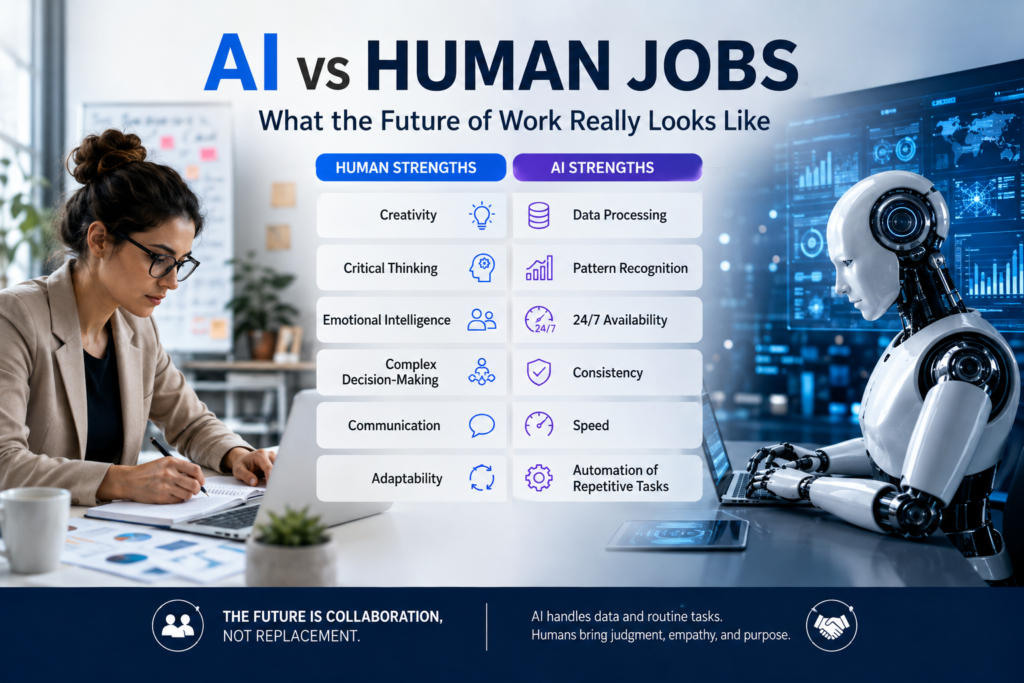
| Area | AI Strengths | Human Strengths |
|---|---|---|
| Data processing | Fast processing of large amounts of information | Contextual interpretation |
| Repetitive tasks | Consistent automation | Handling exceptions |
| Content drafts | Rapid generation | Original direction and editing |
| Pattern detection | Finding patterns in data | Understanding real-world context |
| Communication | Fast responses at scale | Empathy and relationship building |
| Decision support | Comparing information and scenarios | Responsibility and judgment |
| Creativity | Generating many variations | Purpose, taste, and creative direction |
| Physical work | Automation in controlled environments | Adaptability in unpredictable environments |
| Learning | Rapid access to information | Experience and practical judgment |
This comparison does not mean that AI or humans always perform better in every situation. Performance depends on the task, technology, information available, and quality of human supervision.
What Workers Can Do Right Now
You do not need to predict exactly what the workplace will look like in 2030.
Instead, focus on becoming useful in a workplace where AI is increasingly available.
Step 1: List Your Regular Tasks
Write down the major activities you perform during a normal workweek.
Separate them into:
- Repetitive tasks
- Analytical tasks
- Creative tasks
- Communication tasks
- Decision-making tasks
- Physical tasks
Step 2: Identify Tasks AI Can Assist With
Look for activities where AI can reasonably save time without creating unacceptable risks.
For example, you might use AI to summarize meeting notes, generate a first draft, organize information, or create a checklist.
Step 3: Keep Your Judgment in the Workflow
Do not automatically accept AI output.
Review it, correct it, and improve it.
Step 4: Develop One New Skill
Choose one skill that complements your current work.
That might be data analysis, AI-assisted research, automation, presentation skills, cybersecurity basics, or another relevant area.
Step 5: Document Your Results
Track whether AI actually helps you.
For example:
Before AI: 3 hours to prepare a weekly report.
After adopting an AI-assisted workflow: 2 hours, including verification.
This gives you a more useful measure than simply saying that you “use AI.”
What Will the Future of Work Really Look Like?
The future is unlikely to produce a simple division where AI performs all valuable work and humans perform everything else.
Instead, workplaces will probably contain a mixture of automated tasks, AI-assisted tasks, and human-led responsibilities.
Some occupations will shrink.
Some will grow.
Some will change substantially without disappearing.
New roles will emerge around technology, data, implementation, security, and AI management. At the same time, many traditional professions will continue to exist while their daily workflows change.
The pace of change will also vary by industry and country.
The IMF notes that AI exposure differs substantially between advanced, emerging, and low-income economies.
That means there is no single global timeline for AI replacing or transforming jobs.
Frequently Asked Questions
1. Will AI replace most human jobs?
There is currently no reliable basis for saying that AI will replace most human jobs. Research from the ILO indicates that most occupations exposed to generative AI are more likely to be transformed than completely eliminated because human involvement remains necessary for many tasks.
2. Which jobs are most at risk from AI?
Jobs with a high concentration of predictable, digital, and repetitive tasks can face greater exposure. Clerical occupations have particularly high exposure to generative AI according to the ILO’s 2025 analysis.
3. What jobs are safer from AI?
No occupation can be considered permanently protected from technological change. However, jobs involving complex human relationships, physical work in unpredictable environments, professional judgment, leadership, and responsibilities that require substantial context may be more difficult to fully automate.
4. Should I learn AI to protect my career?
Learning how AI affects your profession can be useful. You do not necessarily need advanced programming skills. Start by learning how to use relevant AI tools responsibly, verify their output, and combine them with strong professional knowledge.
5. Will AI create new jobs?
AI is expected to contribute to the creation of new roles, although the exact number and types cannot be predicted with certainty. The World Economic Forum’s 2025 employer survey projects substantial job creation and displacement through 2030, with technology among the major drivers.
Conclusion
The AI vs human jobs: what the future of work really looks like debate is often presented as a choice between people and machines.
The evidence points toward a more complicated future.
AI can automate certain tasks and reduce demand for some types of work. It can also help workers perform tasks faster, support new business models, and create demand for new skills and occupations.
For workers, the practical response is to understand AI, strengthen your professional expertise, improve your ability to evaluate information, and develop skills that complement technology.
For employers, the challenge is to introduce AI responsibly, train employees, measure quality, and decide carefully which tasks should be automated and which require human judgment.
The future of work will not be determined by AI alone. It will also depend on how workers, businesses, educators, and policymakers respond to the technology.
The most useful question for your career may therefore be:
Which parts of my work can AI improve, and which human capabilities can I develop that remain valuable when AI becomes more capable?